OMO AI: learning games that teach kids ideas before numbers
PRESS START ON SCHOOL.
OMO AI is an AI-powered learning-games platform for children in Class 2–4 (ages 6–10) in India. Our first game teaches the ideas of maths (quantity, comparison and probability) without numbers.
Pick the bag.
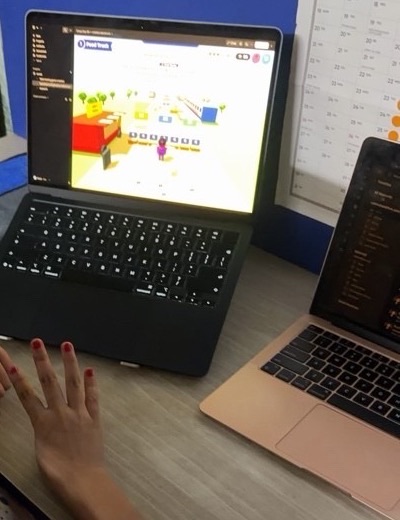
Our first game. You reach into a bag without looking. Which bag most likely gives you the ball shown? No numbers, just a feeling for "more likely".
Every level here was designed and generated with Claude. Difficulty is adaptive (rule-based today; Claude-powered with credits).
Peek at the level data
Loading…
All 60 levels (levels.json) · How we made the levels
See OMO in action
Introducing Omo AI (video). How OMO introduces ideas like quantity, patterns, sequencing, language and reasoning through imaginative worlds (jungles, galaxies, oceans, stories) before children meet formal symbols. Watch on YouTube.
Children learn to fear learning early.
OMO AI is building an agentic AI that turns imagination into the gateway to abstraction: immersive, gamified worlds for foundational literacy and numeracy (FLN) in Class 2–4. Kids learn the ideas (quantity, pattern, sequence, language, reasoning) before they meet letters and numbers.
Built for India's first-generation and multilingual learners. Inclusive design with neurodivergent learners in mind is next.
Only 23.4% of Class 3 children can read a Class 2-level text (rural India, government schools).
ASER 2024, official national findingsOnly 33.7% of Class 3 children can do basic subtraction (rural India, all schools).
ASER 2024, official national findingsof students in Classes 9–12 report anxiety because of exams and results (NCERT survey of 3.79 lakh students, 2022).
NCERT, Mental Health and Well-being of School Students · reportASER shows whether children can read and calculate. OMO targets the deeper gap: whether they understand the ideas well enough to use them.
Gaps open in the first years of school and widen from there. When learning arrives as rote, pressure and punishment, many children decide they are simply "stupid" at maths, long before they meet the ideas behind it. OMO exists so that no child learns to hate learning. We start with play, where being wrong is just the next try.
Why games work: ideas first, symbols later.
Our method is Play it → See it → Write it, known in maths teaching as the Concrete–Pictorial–Abstract approach. A child first handles the real thing, then sees it as a simple picture, and only then meets the symbol, so the symbol stands for something they already understand.
Example, "more likely": the child picks between two bags of balls and feels which one wins more often (play it). Next they see the same bags as rows of dots, three pink out of four against one in four (see it). Only later do they write it: ¾ is more likely than ¼ (write it).
Aligned with national policy
- NEP 2020 puts play- and activity-based learning at the centre of the foundational stage (ages 3–8).
- NCF for the Foundational Stage (2022) makes play the core of curriculum and pedagogy.
- NIPUN Bharat aims for every child to reach foundational literacy and numeracy by the end of Class 3, by 2026–27.
Try it: one idea, three steps.
The ideas OMO teaches, without numbers.
Numeracy
- LiveChance"This bag will probably give me red." Pick the Bag
- In designQuantity"I can see there are three without counting."
- In designComparison"This plate has more, I can tell by pairing them up."
- PlannedFair share"Everyone got the same, so it's fair."
- PlannedPart–whole"These two pieces make the whole roti."
- PlannedPattern"I know what comes next."
Literacy
- PlannedSounds"These two words start the same."
- PlannedSequence"First this, then that, then the end."
- PlannedStory"I can tell you what happened and why."
- PlannedLanguage"I know this word in Hindi and in English."
How it works, built with Claude.
Today
Claude designed and generated every level of Pick the Bag, in English and Hindi, and helped build this site and the game engine. In the game, difficulty adapts with simple rules in the browser: the game reads play signals (choices, hesitation and retries; rule-based today, Claude-powered with API credits), and the next level gets harder when the idea clicks and gentler when it hasn't.
- ConceptAn idea a child should feel, e.g. "more likely".
- ClaudeWrites levels and Hindi/English hints from a short brief.
- Level JSONBags, target colour, answer, concept, hints.
- ValidationA script checks the right bag is truly most likely, with no ties.
- Kid testing5–10 children play each build at home, parents present.
The brief we gave Claude
"Create data/levels.json with 60 Pick the Bag levels across 5 difficulty tiers (easy obvious ratios → close ratios → 3 bags → 'how much more likely' → mixed challenges). Each level includes: bags (colours + counts of objects, rendered as objects, never digits), target colour, correct bag, difficulty tier, the concept taught, and a short kid-friendly hint in English and Hindi."
Excerpt from our working session. Method: how we made the levels.
One resulting level
{
  "id": 13,
  "tier": 2,
  "concept": "Proportion beats count: more of a colour is not enough, the others matter too",
  "target": "red",
  "bags": [
    {
      "objects": [
        {
          "colour": "red",
          "count": 3
        },
        {
          "colour": "blue",
          "count": 1
        }
      ]
    },
    {
      "objects": [
        {
          "colour": "red",
          "count": 5
        },
        {
          "colour": "blue",
          "count": 5
        }
      ]
    }
  ],
  "correct_bag": 0,
  "chance": [
    "3/4",
    "1/2"
  ],
  "hint": {
    "en": "More red is not enough. Look at the other balls too!",
    "hi": "सिर्फ़ ज़्यादा लाल काफ़ी नहीं। बाकी गोले भी देखो!"
  }
}Next Planned · needs API credits
- Play signalsChoices, hesitation, retries.
- Learner stateWhat the child already understands.
- ClaudeSelects or creates the next level for this child.
- Adult noteA plain-language note for parents and teachers.
Responsible AI for children.
OMO is built for 6–10-year-olds, so safety is part of the design, not an add-on.
- Children never chat with the AI. Claude works behind the scenes: it generates structured game levels (bags, colours, hints), not open conversation.
- Everything is validated before a child sees it. A script checks every generated level (the right answer is truly correct, hints are short and age-appropriate), and we review content before it ships.
- Adults are present. Play is supervised by a parent or teacher, at home or in class.
- No personal data from children. We don't ask children for names, photos, locations or contact details. On this website, play stays in the browser and nothing is sent anywhere.
- AI is disclosed to adults. Parents and teachers are told clearly where and how AI is used in OMO.
- Parents are in control. Parents can ask to see or delete any data at any time: satyam@omoai.lol.
We design OMO in line with Anthropic's Usage Policy for products used by minors, and we'll keep strengthening these safeguards (including for future features like the companion character) before any wider launch.
Tested by kids.
Daksh is 8, in Class 3, and has never been taught probability. In our game he picked the bag most likely to win, by feeling "more likely" before knowing any symbol.
Every build is tested by 5–10 children at home, with parents present.
What we've seen
- Kids replay without being asked.
- They grasp "more likely" before they meet the symbol.
- Hindi and mixed-language hints hold their attention better.
- Pace varies hugely at the same age, which is why we're making it adaptive.
Where OMO is going. Concept

चलो, थैला चुनो!
Let's pick a bag!
Progress note
Daksh understands more likely.
Next: comparing chances.
How OMO will reach children. Plans
Parents
An app for low-cost Android phones that works on slow connections, Hindi-first.
Schools
Classroom play sessions with a simple teacher view of who has understood what.
Partners
State foundational literacy and numeracy programmes, CSR initiatives and NGOs.
Top 10 in India.
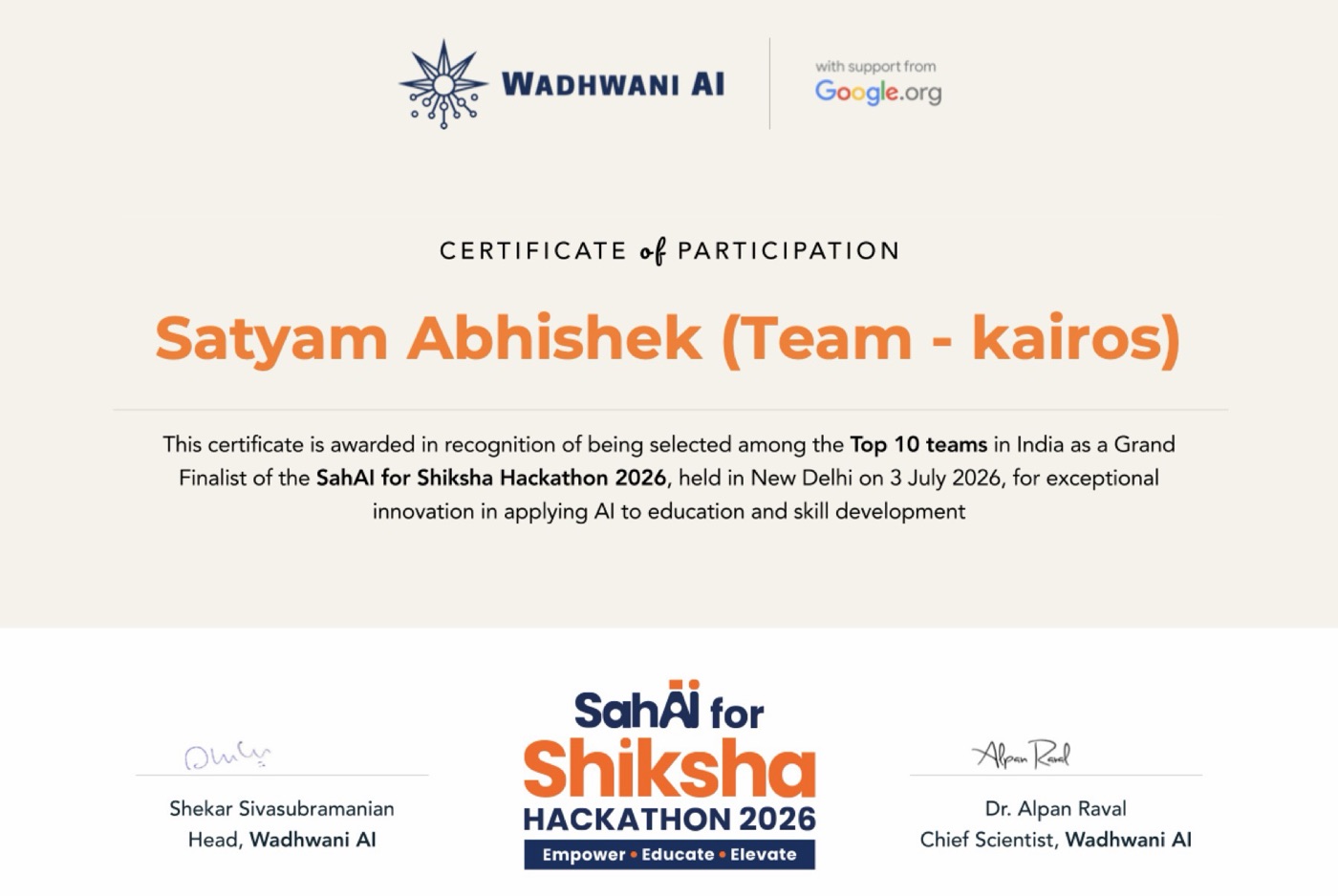
Presented at the SahAI for Shiksha Hackathon 2026, a national initiative by Wadhwani AI with support from Google.org, facilitated by Reskilll. Selected among the Top 10 teams in India as a Grand Finalist. Built by founder Satyam Abhishek as Team Kairos. OMO AI is a registered MSME: Udyam UDYAM-BR-26-0253988.
Safety and questions.
- Adult-supervised play. Children play with a parent or teacher nearby.
- Minimal data. We collect only what is needed to adapt the game. On this website, nothing is sent anywhere.
- Children never chat with the AI. Claude only generates structured game levels.
- Age-appropriate content. Generated levels are structured, validated and designed to be age-appropriate.
- Parents in control. Ask us to see or delete a child's data any time. Privacy policy
Who is it for?
Children in Class 2–4 (ages 6–10) in India, especially first-generation and multilingual learners, and the parents and schools who teach them. Inclusive design with neurodivergent learners in mind is next.
Is it safe?
We design for safety first: children never chat with the AI, every generated level is validated before a child sees it, play is adult-supervised, we collect no personal data from children, AI use is disclosed to adults, and parents stay in control. Responsible AI for children.
What does the AI do?
Today, Claude designed and generated every level of Pick the Bag, in English and Hindi; the game adapts with simple rules in your browser. Next, with API credits, Claude will read how each child plays (choices, hesitation, retries) and create the next level just for them, and write plain-language progress notes for adults.
When can my school join?
We're testing with children at home now and starting school pilots next. Join the waitlist or write to satyam@omoai.lol.
A note from the founder.

I'm Satyam, a first-generation entrepreneur from Patna, Bihar. I build OMO at night, after my full-time job, because I can't stop thinking about one thing.
I have seen how fear and pressure make children hate learning. A child who is scolded for a wrong answer learns to stop trying, and often decides they are "not a maths person" before they are ten.
I believe games are the language children understand. In a game, a wrong answer is just the next try. OMO is my attempt to make the first meeting with big ideas feel like play, in the language a child speaks at home, so no child learns to hate learning.
Satyam Abhishek, Founder · LinkedIn
Join the waitlist.
Parents, schools and partners: write to satyam@omoai.lol.